Rat Guards on Pipes: How Rats Climb Into Buildings and How to Stop Them
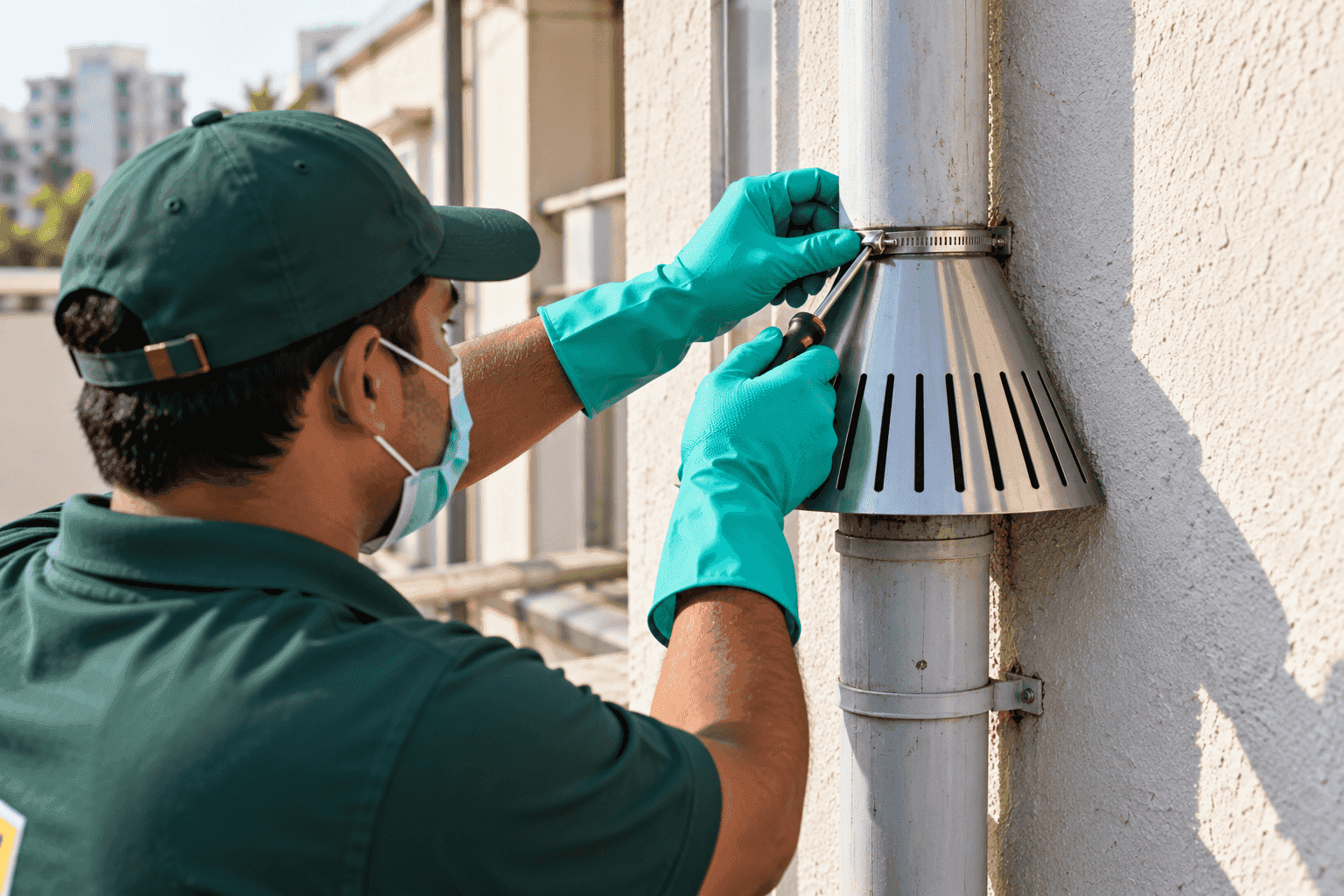
When people think about keeping rats out, they think about doors and floors. But rats are excellent climbers, and the exterior of most buildings is full of ladders: drain pipes, soil stacks, rainwater downspouts and cable risers.
Once a rat reaches the roof, a balcony or an upper-floor window ledge, it only needs a small gap - around a meter box, an AC pipe sleeve, a false-ceiling void or a loose roof tile - to get inside.
How rats use pipes
- Rats can climb the outside of a vertical pipe by bracing themselves against the adjoining wall.
- They can also climb up the inside of pipes up to roughly 100 mm in diameter.
- Older cast-iron or corroded pipework gives their claws something to catch on, so it is easier still to climb.
- The pipe itself does not have to be damaged for it to become a way in.
Why it matters
Rodents chew through wiring, which is a fire hazard. Their droppings and urine contaminate food and surfaces and are linked to diseases such as leptospirosis, salmonella and hantavirus. They also damage furniture, packaging and clothing, and breed quickly once they are inside.
Signs that rats are using a pipe
- Rub marks or greasy smudges running up the outside of a pipe
- Gnaw marks on the pipe, on nearby cable insulation or on an existing guard
- Droppings collecting at the base of a pipe or on a ledge just above it
- Scratching or movement in the ceiling void directly above an exterior pipe run
- Rats seen on a balcony, terrace or upper floor with no ground-level entry point found
What a rat guard is
A rat guard, also called a pipe rodent guard or rat baffle, is a cone- or dome-shaped barrier fitted around a vertical pipe, cable riser or downspout. It clamps around the full circumference of the pipe so its rim projects well beyond the pipe. A rat climbing up meets a smooth, outward-sloping surface with nothing to grip, and cannot reach around or over it.
Because it works on physics rather than poison, a correctly sized and placed guard keeps working for years with no repeat visits, and there is nothing for rodents to eat or avoid.
Size and position decide whether it works
- Size it to the pipe's actual outer diameter - a loose guard leaves a gap, an oversized one will not sit securely.
- Fit it high enough to be out of jumping range.
- Fit it below anything a rodent could use to bypass it: a bracket, a bend, an adjoining wall, a ledge or a branch pipe.
- If a pipe has more than one bypass point, it needs more than one guard.
- Fix it firmly with clamps, straps or screws so it cannot be pushed loose or rotated out of position.
What it is made of
Stainless steel and galvanized sheet metal are the standard materials because they hold their shape, resist rust through the monsoon and cannot be chewed through. PVC guards are used where cost or weight matters more, or on pipes in sheltered locations. In coastal or heavily exposed settings, stainless steel is usually the more durable choice.
What a rat guard cannot do
A guard stops rats from climbing in. It does not remove rats that are already inside your building. For an existing infestation it should be combined with baiting or trapping, and with sealing of the gaps around foundations and utility entries using steel wool, mesh or sealant.
Where it is most needed
- Residential buildings and housing societies with exposed pipes on an outer wall
- Restaurants and commercial kitchens
- Godowns and warehouses
- Hospitals, hotels, schools and colleges
- Older properties with corroded pipework
- Ground-floor units near open drains, construction sites or vacant plots
SSD begins every rat guard job with a walk around the exterior to map every vertical pipe and riser, then sizes and positions each guard against the specific bypass points. In the Mumbai to Thane corridor, rat guard installation is also covered by our 60-minute express response.
Get a free pest inspection
Tell us where the problem is and our team will call you back to confirm.
Need help with this?